The Red Detachment #1: Nuclear Bombs
The Red Detachment is a series of essays started around 09-2025 following a psychotc break. ---
Do you have any strong feelings about the atomic bomb? I just remembered something. A pink sunset. I used to have this idea about nuclear war as a kind of must-happen, pivotal event that we all somehow missed. We ‘luckily’ avoided it, and what we got was cold war, ‘cold’ small scale conflicts, ‘cold’ genocides, and ‘cold’ assassinations.
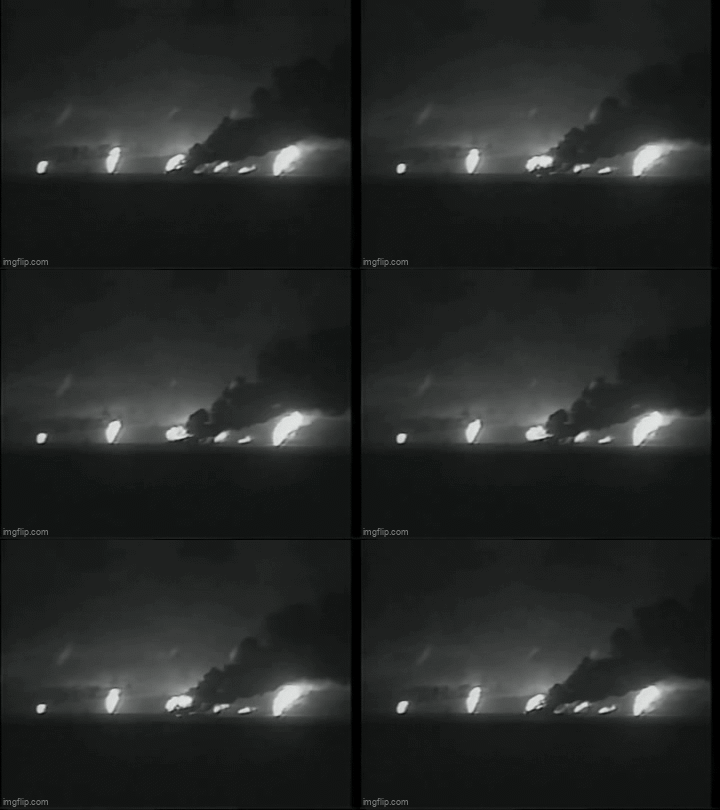
I thought of progress in terms of blood shed. You need a certain amount of blood to move forward in history, to reach the next stage of some kind of development. Blood has to spill, to feed the earth, to oil up the machine. It has to happen. The only choice we make is whether the blood spills at once, in an instance, or trickles down for decades, slowly, painfully, but the price will have to be paid regardless. This is why, in barely-industrialized Russia, in order to collectivize, skip the bourgeois revolution straight into a socialist one, you had to spill a century’s worth of blood in just a few decades. This is the price, I thought, and it would have to be paid either way. Can you quantify human suffering? Only if history has an end. But it does not, so it’s just one card trumps the other, until there’s nobody ‘human’ enough left to perceive. Well in that sense - a sunset, sometime in the winter of 2021. It was a cold school night, I was reading about the Gulf war, and I realized that there is a blood dept that we have been paying. I realized that we, a strange kind of ‘we’ it felt, we were supposed to have had a nuclear war in the 60s, or maybe a bit later. It was supposed to reset us. A kind of bloodletting, that would shock us back into empathy, set us straight, at least for a while, like the Second World War did. Back then I still believed WW2 was different, somehow holy. It showed us how bad genocide is, didn’t it? It gave us the Declaration of Human Rights, didn’t it? But we ‘luckily’ avoided a nuclear holocaust, and what we got instead was ‘cold’ small scale conflicts: Agent orange, missiles designed to pierce bomb shelters; we got thermobaric bombs, bombs that pull your lungs out of your mouth; we got uranium munition, whose purpose is not to shatter bones better, no, it’s real use is burying itself into the ground, contaminating the soil. We did not pay the price, in a flash, in an explosion, the way we were supposed to. We’re paying it back still, in droplets. We are in a limbo of of wounds, small scale, infected, oozing, losing blood but never enough to die, wounds torn open just as they begin to heal. And that is our forever, and ever, because we chose not to do it the hard way, a lot of pain at the same time. I looked at melted human beings, the opposite of fat floating inside of bunkers, and out of all possible emotions, I felt shame for none of us having died in the 60s. That is what I believed, for a long time, and it was a terrifying and beautiful thing to believe in - all feeling is better than no feeling. It made me sick, it made me wish for all of us to die. Time passed. I remember this: For a short while, just after the Russian invasion of Ukraine started, and I was still probably in psychosis, I became convinced it was going to get nuclear. I researched the best ways to survive the blast, what type of house is safest, wanted to speak to my landlady about gaining access to the basement, to hide in.
After a while, I started to feel the scariest thing, a kind of creeping disappointment, in the fact that what we understand as ‘nuclear war’ is not even real, nowhere close to the purifying, all encompassing death I dreamed of. Not that many people would die, some would burn in their basements, the rest would wander, with our skin off, we would drink irradiated water and wear irradiated clothing, drag ourselves to a rescue point, some kind of tent, whole world watches on, and the radiation dissipates pretty quickly, look, they’re already living in Hiroshima, aren’t there enough cities in the world? Not enough people would die for it to matter. As of 2024, the load of bombs dropped on Gaza is comparable to that dropped on Hiroshima. If you can shell a city so much with regular bombs, and nobody stops you, and the dust released by the rubble will make you, and the generations that come after you, and the earth, as sick as any radiation can – then what difference does it make? What’s so special about a nuclear bomb? How is a thermobaric one any better? Again, a thermobaric explosion sucks out your lungs; they hang out of your mouth. Is it the scale? Is it the environmental impact? Why are we trying rationalize this? “What was your number?” Who taught us to count the dead? War rationalizes everything. I’m reading Gravity’s Rainbow. The lover-pair, Roger and Jessica, can’t be together, because the younger, Jessica, is taken by the War, War-raised. She obeys its logic. She cannot love anymore, it’s not a question of choice, she can-not-love, because loving something, believing in something, is irrational, and War is anything but. Instead of inoculating us against war, WW2 did the opposite. It showed us, or at least those paying attention, that all matter of suffering could be rationalized. It could be overcome. It made the machines work so well, sing in a choir, catch up with the plan. And even if, at night, you find yourself trembling under your blanket, your fingernails chewed down to the root, chasing the last part of your mind words cannot express – believe me, it will pass. The change transpired long before you knew it. You will, believe me, live it all down come morning. (I know from observation that when the future comes you will not care for it. I promise that you won’t be scared: My grandpa built parts of the atomic bomb, the landing systems to let it down gently - his own Ternopyl family cut down, from 60% to a 0%, in the War – suddenly he was there, under the dusting polygon, watching the blast. He did not care for it.) The terror of it all is so understandable, it’s logical, man-made, and bearable. And every border breached is a border discarded: What use is a crossed threshold? Nobody ever retreats.
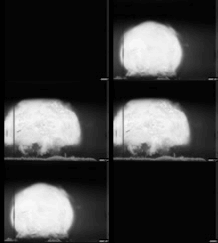
What do I see when I look at the bomb? Another threshold crossed. Now turn around, look back over your shoulder, are you surprised at how painless it actually was? All of that fear, and for what? What do I see? Now, years after the threshold, years of ‘cold’ war, the violence, violence, violence, slowly reshaping us, heads held lower, voices softer somehow, now, looking back at it, what do I see? A broken promise. A broken promise, that’s what it is. Not in the way you think – no. You promised, that it would mean something. You promised, that if we die, that it would mean something. You promised, we would die. Did you know that trinitite, molten sand found on nuclear test sites, has five fold symmetry? The only element on our planet to do so? The bomb changes the structure of the atom to leave behind a pentagram. I want this to touch me, to make me violently sick. I want to ask myself, How could we live that down? How could we? ‘Ah, the limbo of wounds, the yellow decades of dressage…’ - but I don’t believe in that anymore. ‘How could we live that down?’ The answer is, pardon me, ‘very carefully’. I feel pieces of myself breaking off. I was never religious, but this is what I imagine losing your religion must feel like. I ask myself why I believe in the things I do. I can’t justify believing in them any longer. I feel myself a creature of War, a rational creature. I don’t believe in justice except when applied to me, applied as self-punishment; nothing angers me and nothing makes me sad. I do not believe in changing anything. These past few months, nothing has felt real. Everything is the Past: there is the Past, and the Now, which is by now also the Past, and the Future to come, which I can only think of as already the Past. I start to detest other people. They are a foreign body to measure time by, they intervene with my Past-Future trajectory. They don’t belong in my system. A long time ago, I promised to myself I would not give up my beliefs; I wanted continuity, I wanted something to stay with me forever. If I give it up, I’m not sure who I’ll be anymore. I won’t be sure of anything. Any belief I could possibly have would cease to matter. I would have to build myself up anew, piece by piece, no longer restrained by anything. And then I would have to ask myself: Out of all possible things to be, you chose this? Here is a quote from Gravity’s Rainbow:
“I would set you free, if I knew how. But it isn’t free out here. All the animals, the plants, the minerals, even other kinds of men, are being broken and reassembled every day, to preserve an elite few, who are the loudest to theorize on freedom, but the least free of all. I can’t even give you hope that it will be different someday—that They’ll come out, and forget death, and lose Their technology’s elaborate terror, and stop using every other form of life without mercy to keep what haunts men down to a tolerable level—and be like you instead, simply here, simply alive…”
How can I get myself to believe this? I know I don’t believe it now. I want to choose this; how can I choose this?